
Read the Posey County Property Tax Record
Three offices produce the facts in a Posey County property tax record. The Assessor determines market-value-in-use and carries the assessment fields. The Auditor administers deductions and transfer endorsements. The Treasurer issues bills and collects payments. It also reports the current tax route. A parcel number is the best key for keeping those records aligned. Each field still needs its own date or pay year.
| Field | What It Shows | Where |
|---|---|---|
| Land and improvement value | Components used in the parcel's total assessment | Assessor roll or property card |
| Total assessed value | Administrative value for the assessment year | Assessor |
| Deductions | Approved reductions applied under Indiana rules | Auditor |
| Tax bill and status | Installments, amount due, and payment information | Treasurer and tax portal |
| Tax district | Jurisdictions tied to the parcel | Assessment and tax records |
Indiana states a 100 percent assessment ratio. Posey explains its ratio study as assessed value divided by sale price. That formula compares two figures. It is not a promise that a tax assessment equals a future sale price. A deduction also changes taxable treatment without rewriting what a recent buyer actually paid.
Read the record as a dated stack. Land value and improvement value feed the total assessment. A deduction is applied through a separate eligibility process. Taxing districts and rates then shape the bill. Payments and penalties change the balance the Treasurer shows. A later sale can supply evidence for assessment analysis without becoming the tax value itself. When saving a result, record the parcel number. Add the assessment date, pay year, land and improvement components, total assessed value, deductions shown, installment amounts, and the query date. That habit keeps figures from different cycles from being compared as if they were simultaneous.
Posey County's Annual Assessment Calendar
The real-property assessment date is January 1. The Assessor says notices are mailed in April. Exemption applications are due May 15. Reassessment work begins in May, with statutory completion by December 31. Indiana counties reassess 25 percent of property each year. This cycle matters. A deed, owner name, and tax record can disagree after a recent sale.
A sale recorded after the assessment date may appear early. The next administrative roll catches up later. Compare the assessment year, deed recording date, and bill year. Do not label one source wrong. The Assessor's official office page explains market-value-in-use and the annual process.

The Assessor's office page supplies the context behind the value shown in GIS. Save any parcel result with its own visible year.
Note: The county publishes no promise of a same-day owner update after a closing.
Look Up a Posey County Tax Bill
The Treasurer directs users to poseycountytax.com for search, bill printing, and payment. The live application depends on JavaScript, so field layout can vary. Start by identifying the correct parcel through WTH GIS. Then use the exact APN. Use the address mode instead if that is what the tax system offers. Do not infer hidden fields or historical coverage from a loading screen.
- Find and save the parcel number in the county GIS system.
- Open the tax portal's search or View and Print Tax Bill route.
- Confirm taxpayer, parcel, bill year, installments, and displayed status.
- Compare deductions through the Auditor and assessment facts through the Assessor.
- For a delinquency or sale lead, verify the dated official list and later outcome.
- Assessed value
- The administrative value set for the assessment cycle.
- Tax rate or levy
- The applicable rate structure used with taxable value to produce tax.
- Homestead deduction
- A qualifying reduction for an owner's primary residence under Indiana rules.
- Tax lien
- A public claim arising from unpaid property tax, subject to the governing process.
The Treasurer also accepts payment at the office. Listed local banks take payments too. So does the drop box in front of the Memorial Coliseum. Mail is another documented channel. A taxpayer can request a mailed receipt. Include full payment and a stamped self-addressed envelope. Otherwise the portal's print route supplies a bill copy.
The Posey County tax portal is the county-linked online entry. Its live controls require JavaScript to load.

Because the interface depends on loading, keep a parcel number and the Treasurer's office channels as fallback routes. Paper and in-person options still work when the online system does not.
Posey County's 2026 Installments and Penalties
The Treasurer listed the 2026 spring installment due May 11. The fall installment is due November 10. Bills were to be mailed in early April. Both installments could be paid in spring. These dates belong to that stated year. They should not be reused as a perpetual calendar.
The office describes a 5 percent penalty during the first 30 days late. It rises to 10 percent after 30 days. E-check payment carries a stated $1.50 charge. Cards carry a PayPal convenience fee. Verify the live balance and current payment terms before transmitting funds. A saved bill or old county notice can be stale.
Payment evidence deserves the same care as the bill. A printed bill shows what was charged, not that funds cleared. An online status can change after processing. A bank or drop-box payment may not appear the instant it is delivered. Keep the confirmation number, receipt, check record, or stamped correspondence. Tie it to the parcel and installment. If the status stays unclear, contact the Treasurer with the parcel number, payment date, amount, and channel used. Do not submit a second payment based only on an old screen.
The Posey County Treasurer page for tax records lists the official payment routes and dates.

The office page is the authority for payment logistics. The tax portal is the place to check the parcel-specific bill display.
Posey County Homestead Deduction Rules
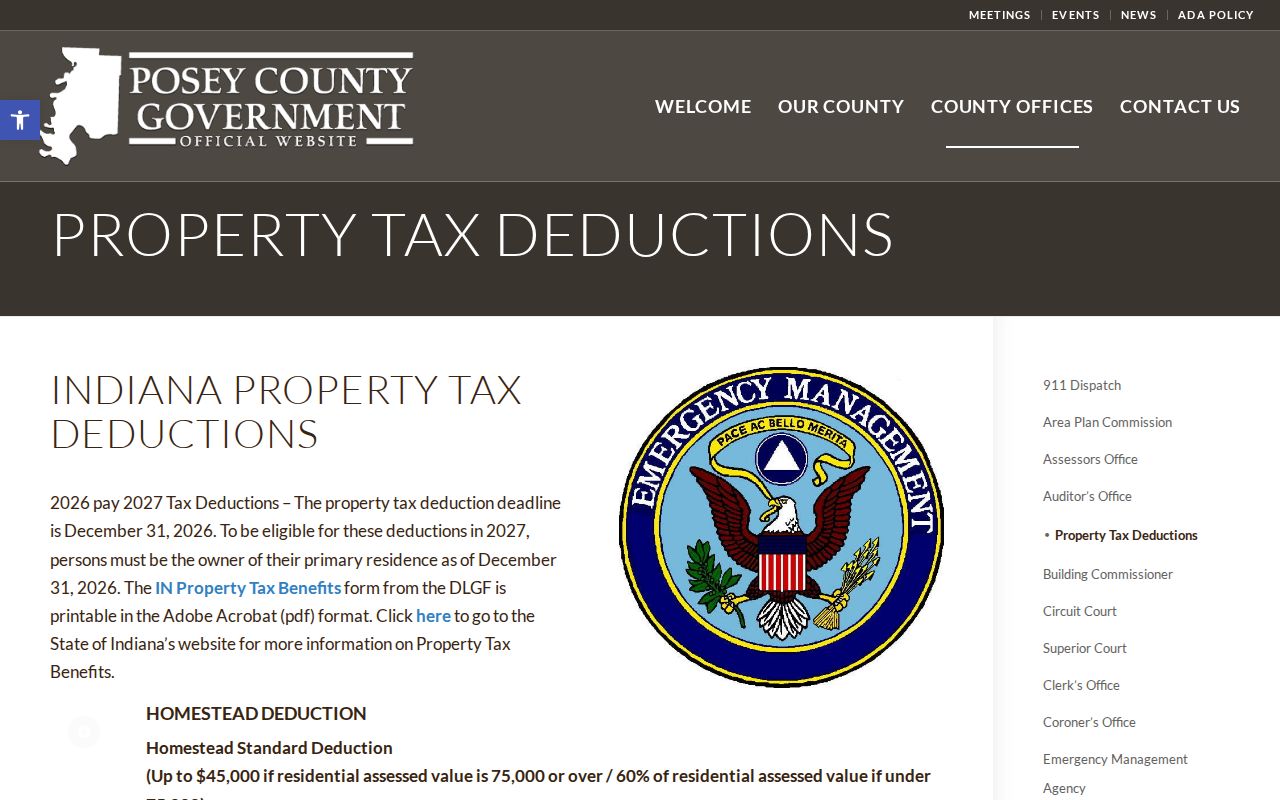
Posey County sets its homestead deduction deadline by a pay cycle the Auditor publishes. For 2026 pay-2027, December 31, 2026 is the controlling date. Eligibility turns on who owns the primary residence on that day. The math works in two tiers. Residential assessed value of $75,000 or more earns up to $45,000 off. Lower values get 60 percent plus a supplemental percentage.
These are qualification and calculation rules. They do not prove any deduction sits on a particular parcel. Verify the actual record before relying on either tier. Ask the Auditor about the proper form. One warning deserves attention. Failure to certify ineligibility within 60 days can trigger repayment plus a 10 percent civil penalty.
Timing drives the whole application. The published rule looks to the owner of the primary residence on the stated December 31 date. The deed, occupancy, and filing cycle all need to line up. Residential zoning alone proves nothing. Neither does an old deduction line or a mailing address. Ask the Auditor which current form and evidence apply. Keep the submitted version and filing confirmation with the pay-year record. The Auditor's property-tax deductions page carries the current local guidance.
Three offices split the tax record in Posey County. The Auditor holds deduction records, the Assessor sets value, and the Treasurer takes payment. Take each question to the office that owns it.
Tax-Sale Lists Are Dated Posey County Leads
Posey County news dated July 16, 2026 announced a tax-sale list. The sale was set for August 31, 2026. A list is only a snapshot inside a statutory process. It does not prove the sale occurred on schedule. Nor does it show that a given parcel sold. It does not show that redemption ran out. It does not show that a deed issued.
For any listed parcel, save the list date and status. Confirm the bill with the Treasurer. Watch for later county notices. Check the Recorder for any resulting instrument. Court or sheriff records can matter too, depending on the proceeding. Never treat an announcement headline as the official parcel-level outcome.
Request Missing Posey County Tax Records
Phone works better than the portal when the numbers do not line up. The Treasurer's office at 812-838-1316 sits at 126 East Third Street, Room 211, in Mount Vernon. Have the parcel number ready. So are the property address, the bill year, and the exact record you want. Assessment questions belong with the Assessor. Deduction paperwork goes to the Auditor instead.
Indiana's Access to Public Records Act, Ind. Code § 5-14-3, backs a request for any existing public record described with reasonable particularity. You may ask for the file in electronic form when the office keeps it that way, and you may request partial disclosure with redaction where that fits. The law does not force an office to build a new research compilation for you, and certain taxpayer detail stays protected.
Note: No universal production deadline or complete live tax-portal field list appears in the official sources.
Challenge a Posey County Assessment on Time
An assessment concern starts with the notice and the Assessor, not the Treasurer's payment screen. Keep the notice date, parcel number, assessment year, and property characteristics. Gather evidence supporting the claimed error. Several official sources can help. These include the property record card, GIS parcel identity, recorded deed, photographs, and comparable sales from the same relevant period.
The published calendar sets January 1 as the assessment date. Notices go out in April. Reassessment starts in May. The cycle turns over 25 percent annually, and exemption filings close May 15. No universal appeal deadline or board form covers every notice. Read the instructions printed on the actual notice. Then confirm the current filing route with the Assessor rather than guessing from the exemption calendar.
Appeal window. Use the deadline printed on the Posey County assessment notice and confirm it with the Assessor. The May 15 exemption date is not a substitute for an appeal deadline.
A successful review changes an administrative assessment only through the proper process. It does not rewrite a deed, settle a boundary, or guarantee a market sale price. For interpretation of the value categories rather than the bill process, see the Posey County property value guide.