
Trace Former Posey County Property Owners by Era
Start from the newest deed and work back one transfer at a time. That habit keeps every Posey County deed record tied to its parcel number, grantor, grantee, book and page, and instrument date. The county's electronic index reaches only so far. Before 1939, deed-book indexes take over, so the search route shifts there.
| Source | Years It Covers | Where Held | What It Shows |
|---|---|---|---|
| Online deed index | 1939 to present, indexing in progress | Recorder through Tapestry or Laredo | Grantor, grantee, document reference, and date |
| Deed images | 1816 to present | Recorder holdings | Recorded text, legal description, and parties |
| Deed-book microfilm | Historic volumes A-Z and 1-38; indexes 1-8 | Indiana State Library inventory and Recorder | Earlier conveyances beyond the online index |
| Maps and plats | Selected items from 1824 to 2011 | State Library and Recorder | Subdivision, tract, road, and ownership context |
A modern transfer begins in the electronic property records index at the recorder's office. Anything earlier than 1939 means turning to deed-book indexes and their images instead. Maps, tax roll entries, directories, and newspapers can offer leads along the way. Still, none of them substitutes for the conveyance chain itself.
Build a Backward Posey Deed Timeline
Log one row per confirmed transfer. A narrative built from names alone hides gaps.
| Transfer date | Grantor to grantee | Instrument | Book/page or document |
|---|---|---|---|
| Newest confirmed recording | Prior owner to present grantee | Warranty, quitclaim, representative, or other deed type | Exact Recorder reference |
| Next earlier recording | Earlier grantor to that prior owner | As indexed | Exact reference |
| Earlier deed-book entry | Names transcribed from the historic index | As written in the image | Volume and page |
Keep the legal description, or the subdivision and lot number, sitting beside your working table. Names alone prove nothing in Posey County deed records, since two men can share one. Matching land is what establishes continuity between owners of record.
Cross Posey's 1939 Online Index Boundary
Posey County deed images reach back to 1816, but the online deed index starts in 1939 and remains a work in progress. That gap matters for any property records search aimed at former owners. A blank portal result does not mean the deed is missing. It often means the name was never electronically indexed at all.
Start with the Indiana State Library's Posey microfilm list to pin down which deed and index runs exist on film. Then contact the Posey County Recorder at 812-838-1314, or visit 126 E Third Street, Room 215, Mount Vernon, weekdays 8 a.m. to 4 p.m. A precise request helps: give names, approximate years, book and page clues, and the legal description.
Online cutoff. Posey's electronic deed index starts in 1939, but deed images extend to 1816. Continue in deed books and microfilm before declaring a chain broken.
Use Every Posey Recorder Access Channel
Tapestry serves occasional users who pay per search, while Laredo suits regular subscribers. The electronic name index stops short of some older eras. The Recorder counter offers direct help with the older deed books. A phone call or email can clarify holdings before you drive over. Ordinary access can fail at times. A focused Indiana Access to Public Records Act request can then pin down a defined instrument or date range. The Recorder's official page lists the current contact routes for the office.
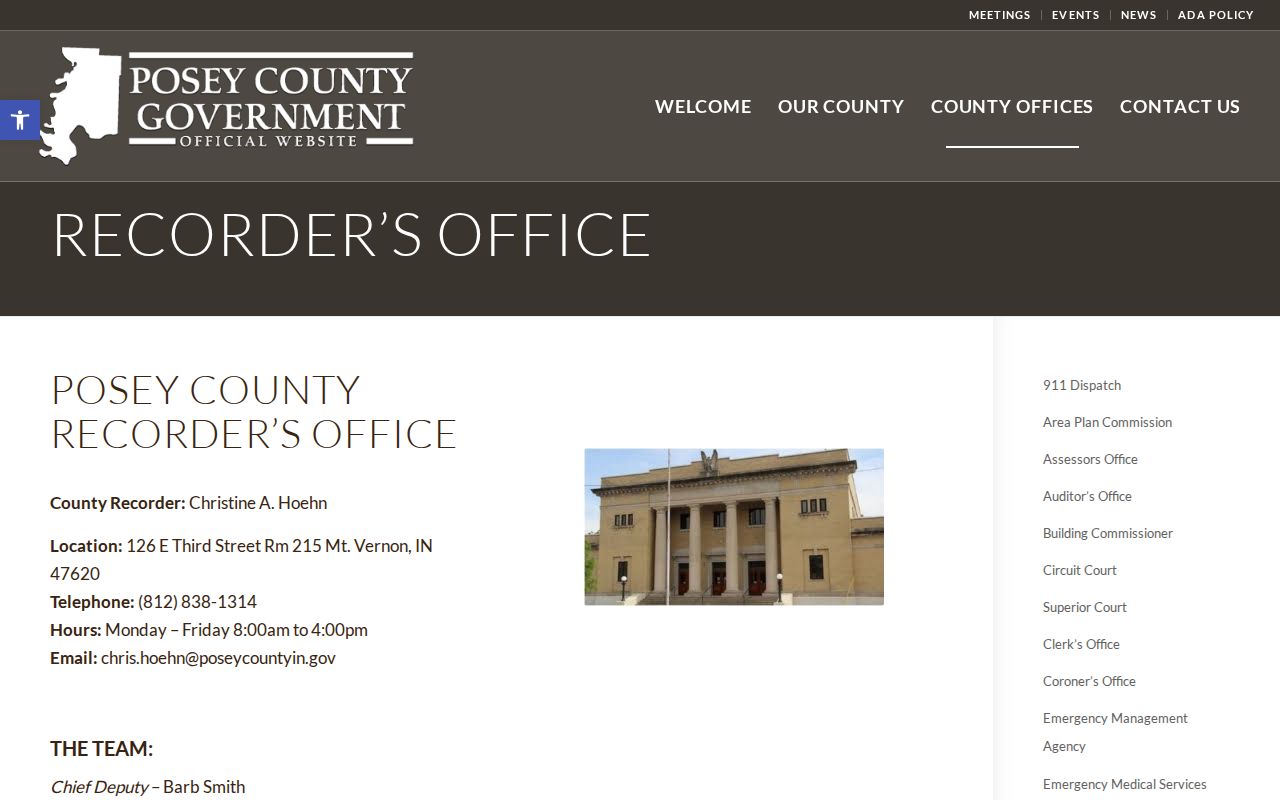
The office page lists contact details and access routes. Even so, the deed-book reference and legal description still unlock any historic record request. For remote historical work, the State Library microfilm inventory helps. Its map collection shows which runs and formats exist. Two local repositories deepen the paper trail.
Alexandrian Public Library and Working Men's Institute hold directories, newspapers, manuscripts, and family collections. These can settle a spelling or locality puzzle. Ask each about its reproduction rules, and cite the collection you used.
Walk the Posey County Deed Chain in Reverse
Start with the current acquisition deed and note its grantor. Then hunt for that same person as the grantee in an earlier deed. That back-step move is the whole method. Run each search with name variants, initials, spouses, and entity names, and lean on the same land description to weed out false matches in the Posey County property records.
- Find the present grantee's acquisition deed and verify the parcel or legal description.
- Record the grantor, deed type, execution and recording dates, and instrument reference.
- Search that grantor as an earlier grantee and confirm the same land.
- Repeat until the index ends, then continue through reverse indexes and deed books.
- Grantor
- The party conveying an interest.
- Grantee
- The party receiving the interest.
- Chain of title
- The ordered sequence of instruments affecting the same land.
- Reverse index
- An index organized to locate a party in the opposite deed role.
- Warranty and quitclaim deeds
- Different conveyance forms; neither label alone proves a complete chain.
Follow Parent Tracts Through Posey Parcel Splits
A modern parcel number may cover only a slice of a much larger parent tract. Old Posey County deed records often skip parcel numbers entirely. Indiana did not require parcel numbers on county transfer documents until April 1, 2022. Match acreage instead. Metes and bounds, section-township-range descriptions, adjoining owners, and plat references carry the chain when an APN is missing from every old instrument.
Some subdivision names act as breadcrumbs. Charles E. Lawrence Subdivision, Pleasant Ridge II, and Country Manor West all appear in the historic record. A replat or lot split can change the parcel ID while a traceable piece of the older legal description survives, so compare the land itself rather than demanding a modern number from each deed.
Bridge Estate and Sheriff-Sale Transfers
A steady buyer-seller rhythm can snap in an instant. An estate, court order, foreclosure, or sheriff sale can step between the parties. Watch for unusual roles. A personal representative, sheriff, commissioner, or trustee listed as grantor signals a transfer outside the normal chain. Indiana MyCase at Indiana MyCase serves as a useful docket lead for these cases. Its historical coverage runs thin before the 1970s. It is also not the official court record, so request the decisive orders from the Posey clerk.
One caution on tax records. A notice, judgment, or tax-sale list alone does not prove final ownership of the parcel. Keep following the paper. A matching deed or other vesting instrument must appear in the official deed records.
Note: Keep court cause numbers beside deed references, but do not substitute a case event for the later recorded conveyance.
Use Posey's Historic Maps as Supporting Evidence
Historic maps anchor a chain of title to real ground. The State Library map inventory lists 1870, 1873, and 1900 Posey and Mount Vernon ownership maps. It also lists 1824 and 1832 New Harmony plans. These plats can tie a former owner of record to a locality, road, parent tract, or subdivision. They reach back decades before current addressing existed.
Two local repositories deepen the trail. The Alexandrian Public Library Indiana Room holds directories, newspapers, census material, obituaries, and courthouse records. Working Men's Institute in New Harmony keeps manuscripts, cemetery files, church records, family Bibles, and newspapers. Treat all of it as corroboration and leads. The recorded deed chain remains the backbone of any Posey County property ownership search.
Audit Each Link in a Posey Ownership Chain
Copy the indexed spelling exactly. For each former owner, log the role, deed type, execution date, and recording date. Keep the book and page or instrument number, and add the parcel number when the index shows one. Include the legal description and acreage too. Subdivision or section-township-range references belong there too. Note the next search you performed beside each entry. That habit keeps a remarriage, changed initial, trustee role, or repeated surname from quietly merging two Posey County people into one.
Street addresses age badly across long stretches. An old deed may describe a parent tract with metes and bounds, while a modern parcel card identifies a smaller tract by APN. Transfer documents required a parcel number only from April 1, 2022, so its absence from a historic deed is expected. Trust the durable land description, and follow it to the later plat, split, merge, affidavit, or conveyance that connects the tract to the modern parcel.
Tax rolls, directories, obituaries, newspapers, maps, and permit records can test a hypothesis. They cannot manufacture a transfer. A directory shows a residence. An ownership map puts a name on the land at one approximate date, yet neither source proves the complete legal interest. Log those items as supporting evidence beside the deed chain, and when sources conflict, preserve both dated statements while seeking the missing recorded instrument.
Finally, separate gaps from conclusions. A missing entry in the Posey County index may reflect the 1939 electronic cutoff, unfinished indexing, a spelling variant, an estate or court conveyance, or a parent-tract description. State which years and books were actually checked. If the trail stops at the 1816 deed images, the Indiana Archives land-office collection covering 1807 through 1861 can supply earlier patent context. The patent still must match the same tract. This audit trail makes the work reproducible. It keeps a plausible family story from becoming an unsupported ownership claim.
Know How Far Back Posey Ownership Records Reach
Posey County deed images reach back to 1816. For earlier or origin questions, Indiana Archives land-office material covers the 1807 through 1861 period and can help locate patents and state land records. A historic map or directory may name an occupant or labeled owner at one date. It cannot fill an undocumented transfer by itself.
When a precise older record is not available online, request a defined name, parcel or legal description, record type, and date range under Indiana's Access to Public Records Act, Ind. Code § 5-14-3. Keep the request narrow. Document the gap honestly. Never label a blank spot in the record as a "missing owner."
Lawful historical use. Research former Posey County owners for property history, estate work, boundary context, or purchase diligence. Never use the chain to track, expose, or harass a living person.