
Read What Posey County Deed Records Convey
A deed in Posey County does several jobs at once. It names the parties, states the type of conveyance, and describes the land being transferred. Look closely at the extras. The instrument may carry a recording date, an instrument number, book and page, a parcel number, consideration language, a preparer, a notary, and references to a plat or an earlier deed. The Recorder also keeps mortgages, assignments, releases, leases, liens, surveys, affidavits, real-estate contracts, and planned-development records. Not every one of those documents transfers ownership. So read each entry for what it actually does.
| Deed Type | What It Does | Common Use |
|---|---|---|
| Warranty deed | Conveys the stated real-estate interest with covenants in the instrument | An ordinary purchase transfer |
| Quitclaim deed | Conveys whatever interest the grantor has without adding a title guarantee | Family, estate, or interest cleanup |
| Trustee or executor deed | Transfers through a fiduciary acting for a trust or estate | Estate and trust administration |
| Sheriff deed | Records a transfer following the required court and sale process | Foreclosure or execution sale |
| Tax deed | Records a transfer after statutory tax-sale steps | Delinquent-tax proceeding |
Know the difference between document types. A mortgage or lien records a claim against the land, not a sale. A later release shows that claim was discharged. A deed and a mortgage recorded near the same closing answer two different questions. So check the document type and party role before treating every name in the index as an owner of record.
Posey's broader recorded collection helps you test a deed in context. An assignment can move a recorded mortgage interest from one lender to another. A release usually refers back to the instrument it discharges. Affidavits can address facts affecting land, while surveys and subdivision plats clarify a legal description. Federal tax liens, mechanic's liens, sewer liens, powers of attorney, planned developments, assumed business names, and UCC filings all appear in the Recorder's published document list too. None of them become transfers just by sitting beside deeds. Before deciding how anything affects the chain, inventory the document type, the party role, the recording reference, and any linked instrument. Check that inventory first.
Posey County Deed Images Reach 1816
The Recorder's coverage table draws a distinction worth noticing. Deed images reach back to 1816. The online deed index, by contrast, starts in 1939. That index is still marked as in progress. So a failed online name search proves nothing about older conveyances. The deed may exist as an image. It might need a manual index, a book-page reference, a public terminal, or a staff-assisted copy request.
| Record family | Image coverage | Index coverage |
|---|---|---|
| Deeds | 1816 to present | 1939 to present, in progress |
| Mortgages | 1990-in-progress to present | 1990 to present |
| Leases | 1864 to present | 1990 to present |
| Miscellaneous | 1965 to present | 1988 to present |
| Dormant minerals | 1972 to present | 1972 to present |
Coverage tells you what the county reports for a category. It does not promise that every spelling or instrument is equally findable online. Keep the recording reference from each deed you find. That reference is more precise than repeating a broad name query.
The Posey County Recorder page is the official route to the office. It carries the deed-system links too.
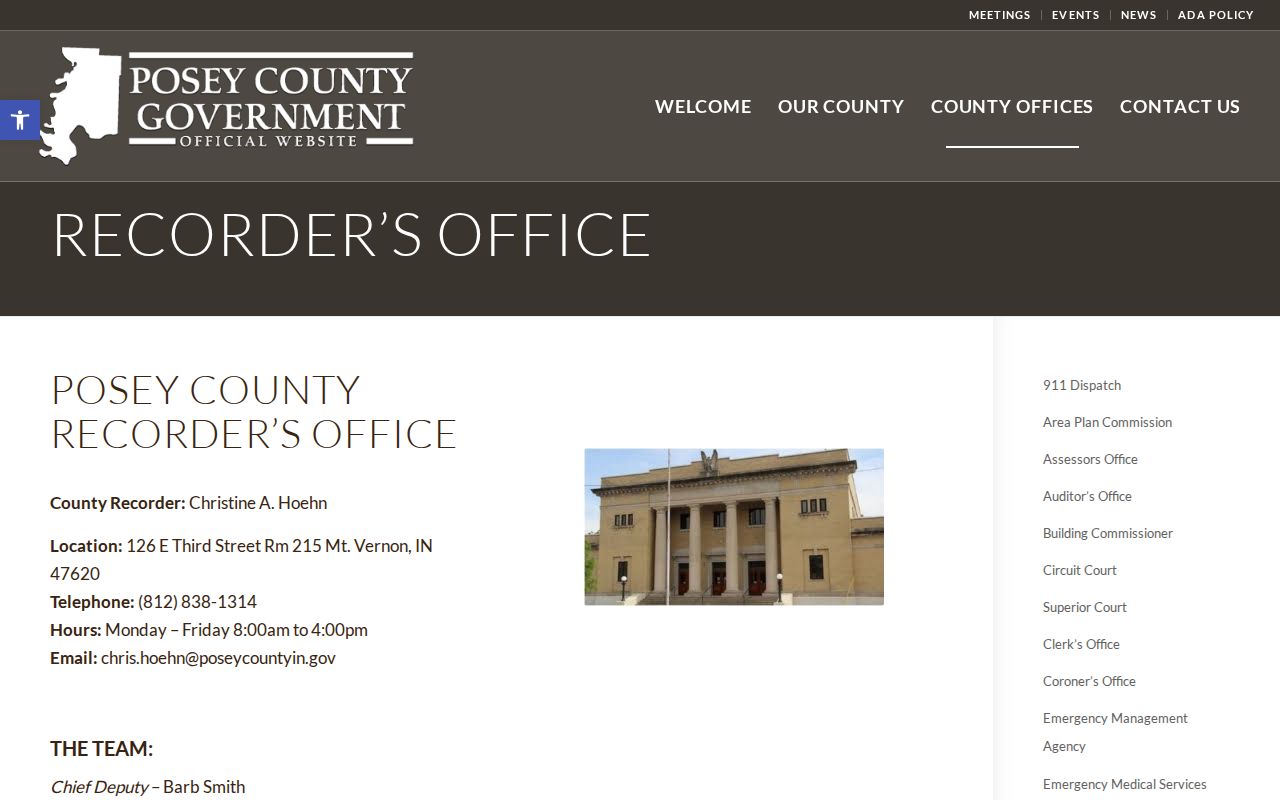
The Recorder's official page connects the online search options to the local custodian. That office remains the fallback for known copies and older index work in Posey County.
Tapestry and Laredo Serve Different Deed Searches
Tapestry and Laredo serve two different kinds of deed search in Posey County. Tapestry is the browser option for occasional remote use. It runs around the clock. It charges $5.95 per search plus $1 per copied image page, per the county's own material. Laredo is the subscription route for frequent users. It offers real-time access with image viewing, printing, and customizable results. Stated plans run from $50 a month for up to 250 minutes to a $250 unlimited tier. Intermediate plans and overage rates sit in between.
Search fields in a dynamic interface shift over time. Stick to the inputs that matter. Use grantor or grantee name, document type, recording date range, instrument number, and book-page reference. Once an image opens, check the parcel number. Verify the legal description too. Names alone can mislead.
Name searching is an iterative task. Try the surname or entity wording exactly as a known deed spells it. Then test initials, spelling variants, former entity names, and the opposite party role. Narrow by date and document type only after the broad name search returns plausible results. For a common surname, the land description is the deciding check. For a company, the Indiana business search can clarify a registered entity's identity. That business record still does not prove which real estate the entity owns.
The Tapestry landing page for Posey County deed records is the entry point for the remote service.
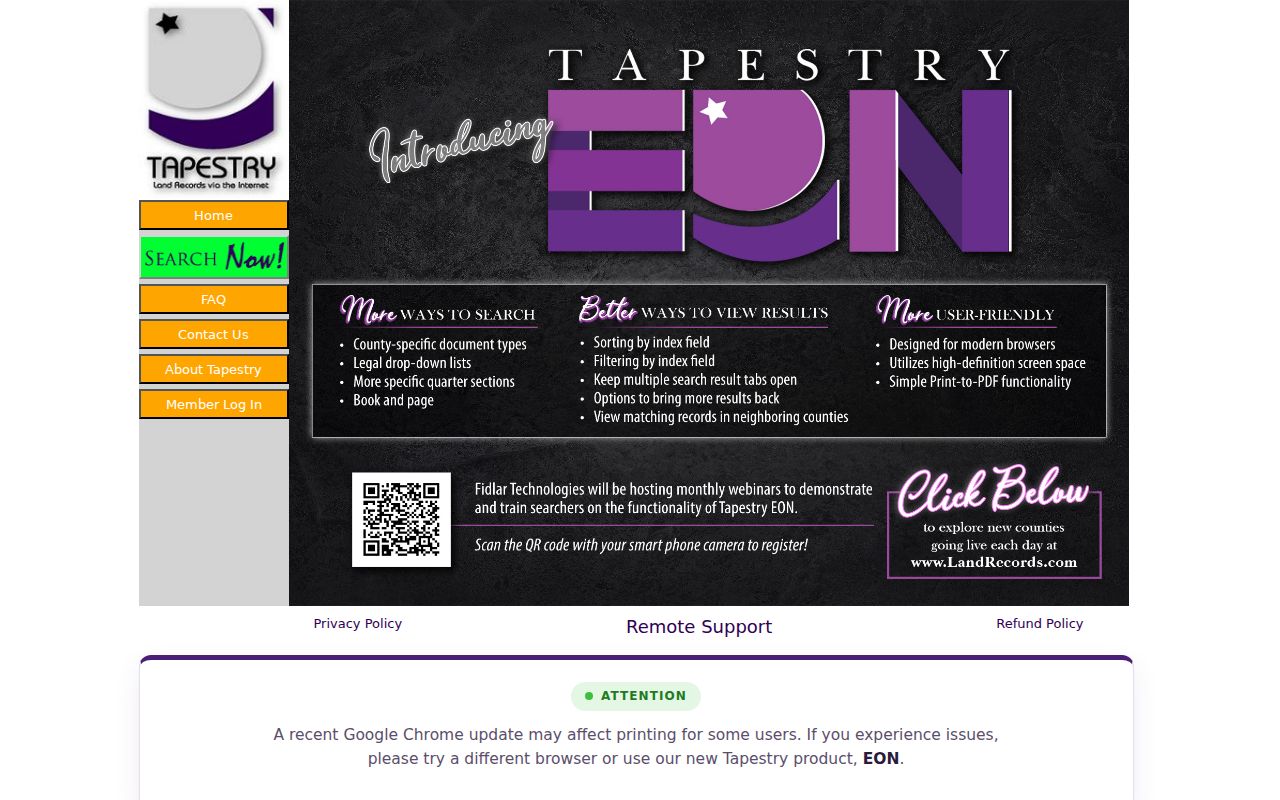
Because the live search is dynamic, confirm current costs and controls at the portal or with the Recorder before starting a large run through Posey County deed records.
Walk Posey County's Grantor-Grantee Index
The grantor index starts from whoever transferred an interest. The grantee index starts from the recipient. To reconstruct a chain in Posey County, begin with a current deed you have positively identified and move backward one acquisition at a time. Compare the land description at every step. People can own more than one parcel, and different people can share a name, so the parcel and its legal description are your anchor.
- Find the present acquisition instrument with the current party shown as grantee.
- Read its grantor, recording date, deed type, legal description, and prior reference.
- Search that grantor as an earlier grantee and open the matching acquisition deed.
- Repeat while checking lot, subdivision, acreage, and book-page continuity.
- At the 1939 online cutoff, move to the manual indexes, deed books, or microfilm.
- Grantor
- The party conveying the interest stated in an instrument.
- Grantee
- The party receiving that stated interest.
- Chain of title
- The connected sequence of transfers affecting the same land.
- Book/page and instrument number
- Two systems for citing the exact recorded document.
Some events break the simple buyer-seller pattern. Estate, trust, court, sheriff, and tax-sale deeds all pass title through an authority. They do not pass title through an ordinary sale. When a deed points to a court cause or a fiduciary, inspect that source. Skipping from one familiar surname to another is how chains go wrong. That shortcut breaks chains in the deed records.
Parcel Numbers Join Recent Posey County Deeds to GIS
Posey County set a new rule on April 1, 2022. Transfer documents must now carry a parcel number, under Ordinance 2022-01-19-01 recorded as document 202200407. That requirement ties newer Posey County deeds to the assessor's parcel data. It also links them to the GIS map. Older deeds got no retrofit. An early instrument may rest on parties, book and page, and the legal description alone.
Punctuation adds a wrinkle. The local APN can read 65-03-01-300-004.001-020. A state data service strips the punctuation from the same parcel number. Keep both forms handy. Then compare the deed's subdivision, lot, section-township-range, acreage, and boundary calls before trusting a numeric match. Numbers point; descriptions decide.
Note: A parcel number is an administrative cross-reference. The deed's legal description states the land being conveyed.
Named Posey Plats Supply Better Search Clues
Plats and agendas drop real breadcrumbs. A 2026 sheriff-sale notice names Charles E. Lawrence Subdivision, Deed Record 122 page 136, at 1835 Allyn Drive, parcel 65-27-06-110-023.000-018. County planning minutes describe a Pleasant Ridge II replat of lots 19, 20, and 21 at Ridgeview Lane. A BZA agenda cites Country Manor West lots 27 and 28 near Loren Drive.
Every item is a lead. None settles title. Retrieve the cited deed or approved plat, inventory the parties and legal description, and confirm the replat was recorded. Agendas can describe proposals that changed or never happened. A sale notice proves no final deed.
Older Posey Deed Books and Ownership Maps
Older Posey County deed books sit in the Indiana State Library's microfilm collection. The guide covers deed records and grantor-grantee indexes, including early volumes. Map holdings span town plans and ownership maps. The dated material runs from 1870 to 1873. A 1900 illustrated atlas is also included. A historic owner label can suggest a surname and place for an index search. Only the linked deed sequence establishes continuity.
The State Library's Posey map and plat inventory works well as a visual finding aid.
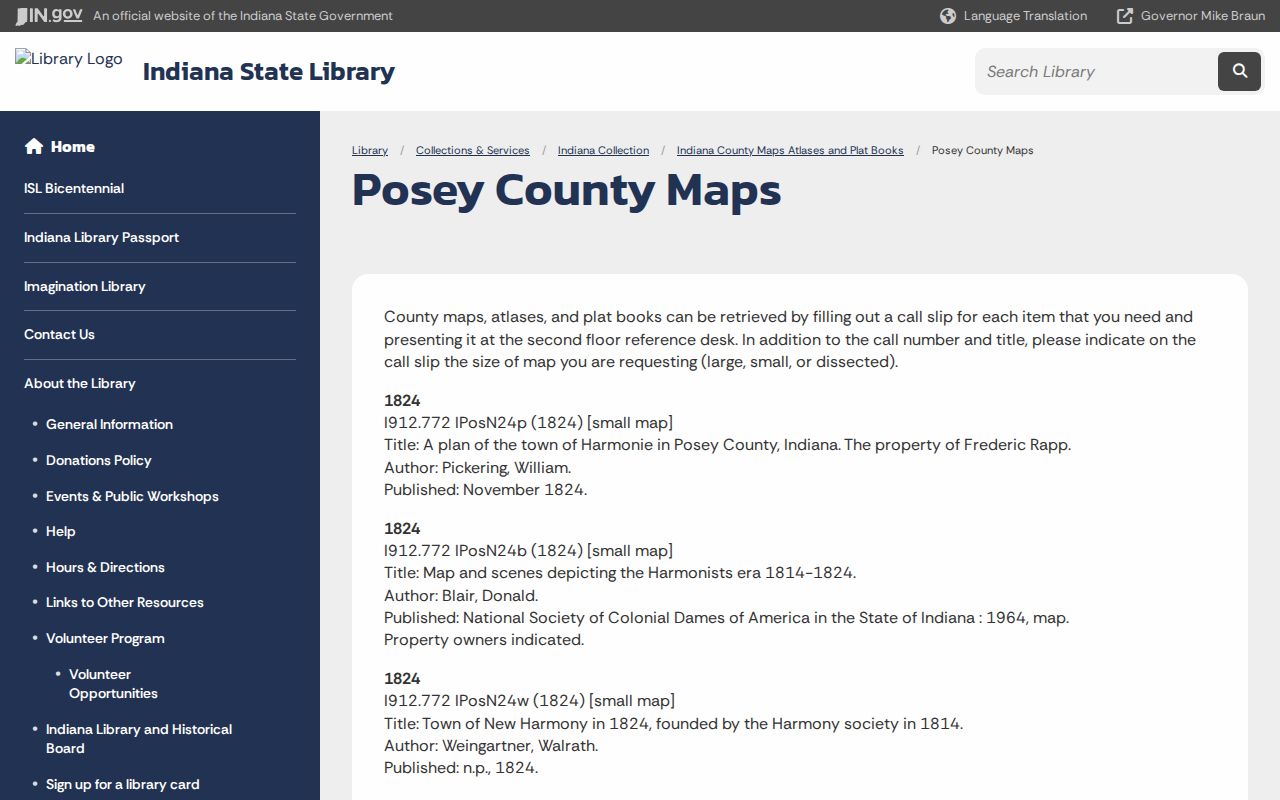
A map is a starting point, not a substitute. Use its date, title, repository citation, and visible owner label to frame the next deed-book request for Posey County records.
Order a Posey County Deed Copy
The Posey County Recorder is Christine A. Hoehn. Her office sits at 126 E Third Street, Room 215, Mount Vernon, Indiana 47620, phone 812-838-1314. Hours run Monday through Friday, 8 a.m. to 4 p.m. Copies cost $1 per page, per the county page. Tapestry images, Laredo access, courthouse public computers, and a request for a known document are all documented channels.
Bring details. An instrument number, grantor and grantee, recording date, book and page, parcel number, or legal description each speeds the search. State your delivery format. Ask staff to confirm the charge. If the record is missing from the online index, ask which manual index or deed book covers the period. Under Indiana APRA, a defined existing record may also be requested with reasonable particularity.
Recorded, not guaranteed. Posey County deed records show filed instruments, not a legal opinion that title is clear. Unrecorded interests, court orders, easements, and other claims can require further work.
The Recorder links a Property Fraud Alert service. A subscriber gets notified when a document is recorded against a watched name or property. An alert prevents nothing and proves no fraud. Treat it as a prompt to open the instrument and contact the custodian.